Cmc 2 1 Color Difference Explained
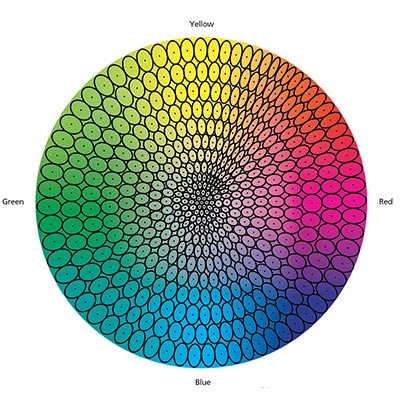
The CMC ellipse is unique in that the shape of it changes depending on where the standard is in color space. Adopted a ratio of 21 while the plastics industry is recommending 1371.
Color Consistency With The Cmc Tolerance System
A 21 ratio will allow twice as.
. DH 2C 1 C 0 12 sin Dh2 Where C 0 C 1 are chromaticities of the colours being compared and Dh is in the range 180. CMC colour difference formula. A dE CMC value of 1 represents an approximate visual difference for a very flat uniform surface such.
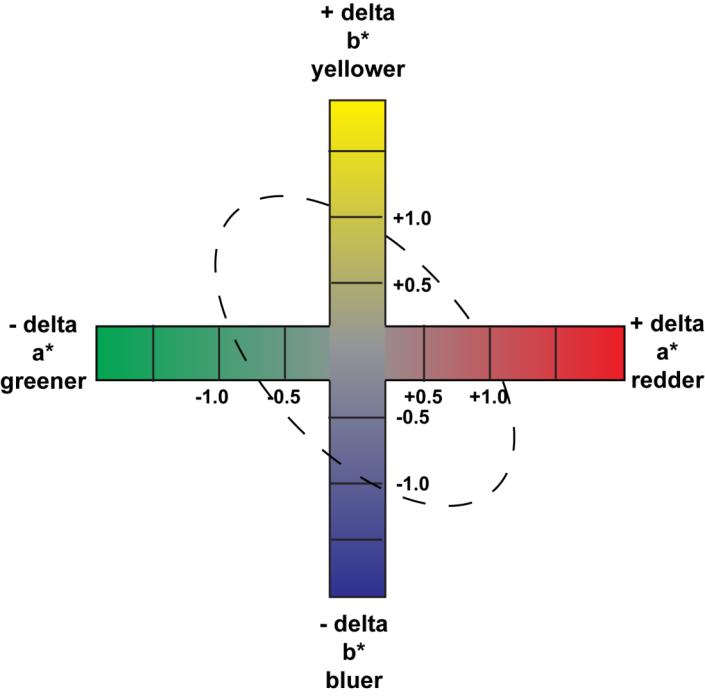
The dotted line shows the effect of changing the lc ratio to 141. There is a need to distinguish between the two. The formula is based on first measuring the reflectance of the stained and unstained materials and calculating the CIELAB color difference ΔE and the magnitude of the lightness difference ΔL between the stained and unstained reference to two decimal places using the CIE 1964 10 supplemental standard observer and illuminant D 65 with the 1931 2 observer and illuminant.
In 1994 the CIE released a new tolerance method called CIE94. In the CIELAB system the total Color difference Delta E combines the difference of three variables L a and b or L c and h. DE94 Delta E 94.
CMC color difference D ECMC a modification transformation of CIE LCh color difference has proven to be a useful measure of. Definition of Hunter L a b and FMC-2 Color Difference Space Worked examples of all color difference metrics including dE and dEcmc and their components in Appendix A. These values can be converted into Color difference values using CIELAB and CMC mathematical equations.
Like CMC this tolerancing method also produces an ellipsoid but you can control of the lightness kL to. Not perceptible by the human eye. The most common values are 21 for acceptability and 11 for imperceptability.
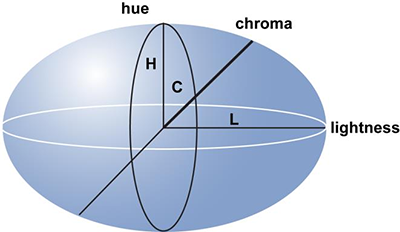
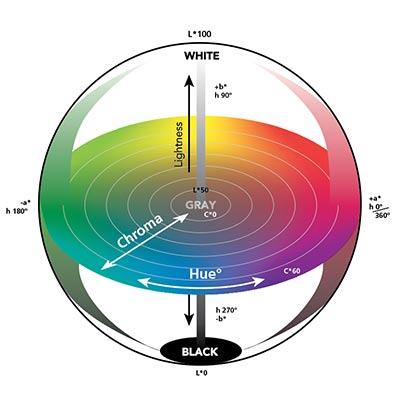
CMC is not a color space but a color tolerance equation based on CIELch. This tolerance ratio lc is considered to be 21. Supported color spaces include Rgb Cmy Cmyk Hsl Xyz CIE-Lab CIE-Lch and Yxy.
Enter values for your chosen color spaces and well calculate delta-e for you using the CMC lc algorithm. Using the CIELAB System. A color-difference unit based on the uniform chromaticity scale of Hunter 1942 was designated the National Bureau of Standards NBS unit or modified Judd.
Chroma c a default ratio for lc is 21. C is 21 which doubles the tolerance of variation for lightness then that for. Another more complicated colour difference formula which is better than DE for evaluating small colour differences is the CMC colour difference formula.
Color differences deal primarily with perceptibility of differences while color tolerances deal with acceptability of differences. The CMC equation allows this ratio to be adjusted to achieve better agreement with visual assessment see Figure 20 on page 18. CMC as a single number tolerance can be used as a Go No Go gage.
The Cmc lc formula allows for lightness and chromas values to be passed in as well. 212 SL 1 SC 10045C ab SH 10015C ab kL kC kH 1 for reference conditions C ab q C ab0C ab1 11 Other CIELAB-based color-difference equations include CMC and BFD 2. SL 0040975L 1001765L unless L 16 when SL 0511 SC 00638Cab 10.
Perceptible at a glance. The color difference method of the Color Measurement Committee the CMC is a model using two parameters l and c typically expressed as CMC lc. Given two colors in CIELAB color space and the CIE76 color difference formula is defined as.
The worked examples are especially good for verifying color calculations and use 10 color difference pairs in different areas of color space. Perceptible through close observation. 0 - 1 A normally invisible difference 1 - 2 Very small difference only obvious to a trained eye 2 - 35 Medium difference also obvious to an untrained eye 35 - 5 An obvious difference 6 A very obvious difference Delta E sample comparison Sample 1 Sample 2 CIE Lab 678 CIE Lab 1678 CMC 995 CMC 563 Tolerance method Agreement with.
Delta E is measured on a scale from 0 to 100 where 0 is less color difference and 100 indicates complete distortion. Δ E a b L 2 L 1 2 a 2 a 1 2 b 2 b 1 2. CMC DL lSL2 DCab cSC2 DHab SH205.
A 21 ratio will allow twice as much difference in lightness as in chroma. All equations show in drop in cor-. In most cases color differences between the recipe-based reflectance factors and the spectrophotometric response of the reference in terms of CIELAB and CMC21 distances 1.
However this correlation is reduced as the lightness of the samples increases until a lightness values of about 45. CMC Color Difference and Tolerances The CMC color difference formula is based on the colorimetric principles of the CIE 1976 system. Figure B shows the CMC calculated ellipsoid with a lc ratio of 21 as it would appear around a color standard.
It is not a color difference. Much difference in lightness as in chroma. Displaystyle Delta E_absqrt L_2-L_12a_2-a_12b_2-b_12.
It is typically employed as a color tolerancing system in industrial applications. DH is usually used instead of Dh to enable DE to be calculated. The expressions for these colour differences are DL Da Db or DL DC DH D symbolises delta which indicates difference.
The CMC equation allows for the ratio between lightness and chromaticity lc to be adjusted to better match acceptability. As explained in this guide by Zachary Schuessler standard perception ranges are as follows. The color difference or ΔE Δ E between a sample color L2 L 2 a2 a 2 b2 b 2 and a reference color L1 L 1 a1 a 1 b1 b 1 is.
If Dh is outside this range then 360 is added or. Color differences calculated using the CMC method are believed to correlate better with visual assessment than other color differences. The parameter Delta E represents Color difference.
Commonly used values for acceptability are CMC 21 and for perceptibility are CMC 11. The CMC equation allows this ratio to be adjusted to achieve better agreement with visual assessment. The lightness l attribute is weighted twice as heavily as the hue and chroma c attribute.
The CMC lc was developed based on the visual evaluation of textile samples and human vision sensitivity levels in the lightness l and the chrome c the default ratio of l. From Figure 4 it can be seen that the CMC 21 equation and ΔE2000 have the strongest correlation be-tween the perceived and calculated color differences for the darker colors.
Tolerancing Part 3 Color Space Vs Color Tolerance
Color Consistency With The Cmc Tolerance System
Tolerancing Part 3 Color Space Vs Color Tolerance

Comments
Post a Comment